
Osage
…in the Cobbs Creek neighborhood of West Philadelphia became MOVE’s second headquarters where John Africa took refuge after his 1981 acquittal. His sister Louise James Africa, who was one of the founding members of the organization, owned the house at 6221 Osage Avenue that would become the center of MOVE’s activity from 1981-1985.

Daily Life
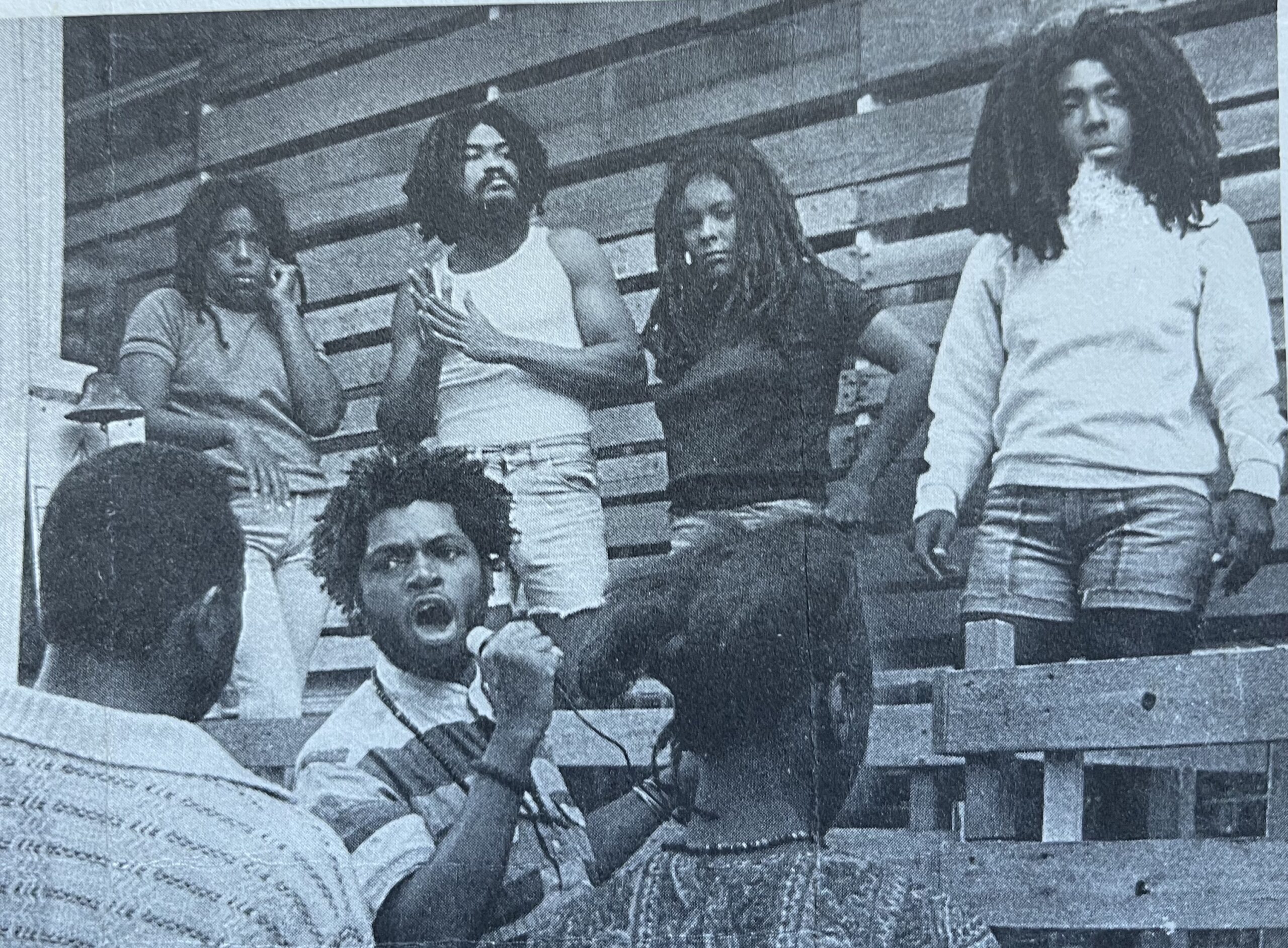
An average day at Osage Avenue for MOVE members including selling watermelons for income, exercising, meetings, and fighting. MOVE members were engaged in three levels of fighting: (1) the fight to free The MOVE 9, (2) the struggle to convince society about the endangerment of Life, (3) and internal struggle to keep MOVE members focused on John Africa’s belief. Life at Osage Avenue was a time of turmoil, with fleeting moments of happiness.
Gallery
The Watermelon Activity
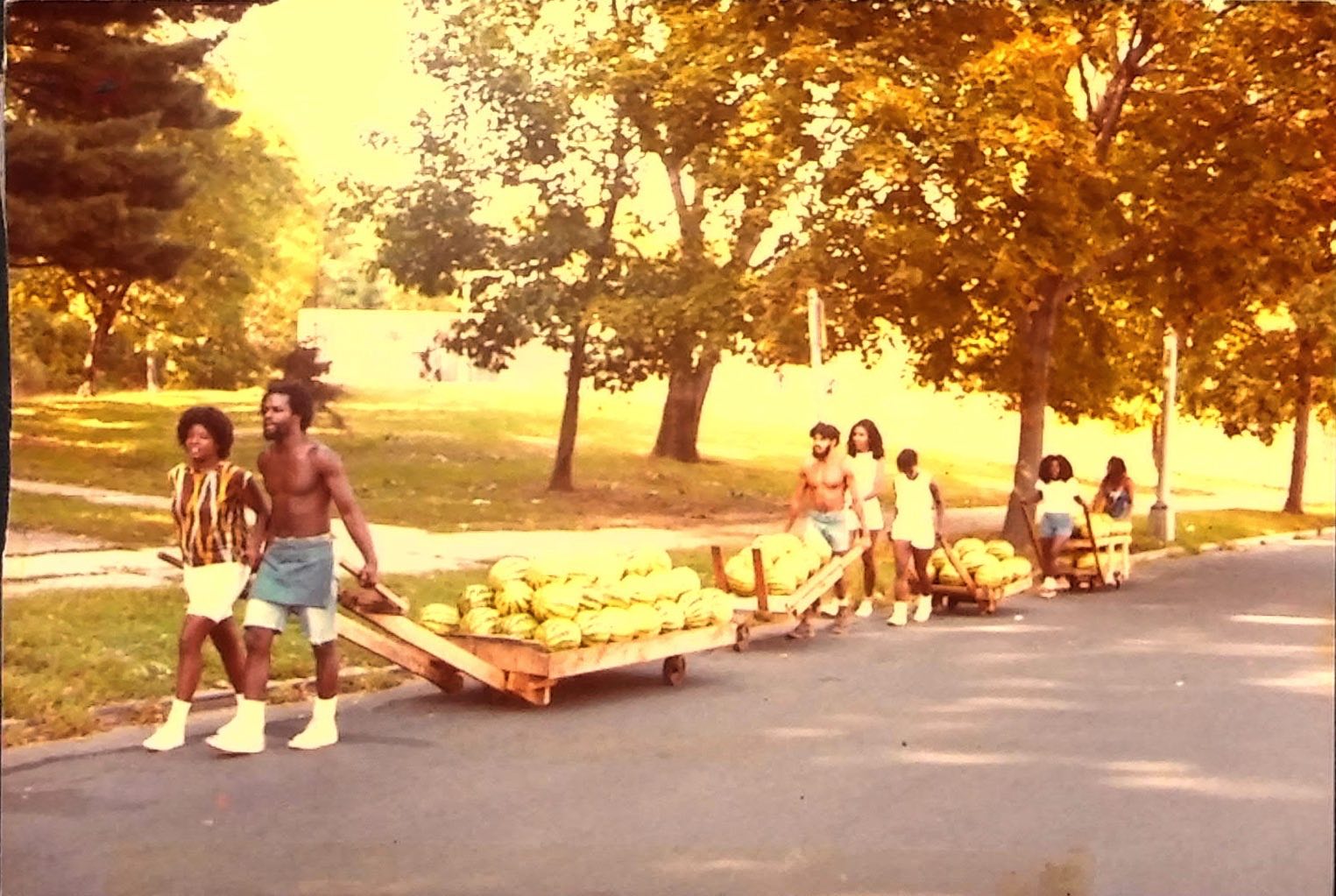
In keeping with traditional MOVE practice of self-sufficiency and sel-reliance, these images depict MOVE members selling watermeolons, which between 1982 and 1985 was MOVE’s main source of funding. John Africa built the wooden carts the watermelons were carried on. [026]

Children’s Story from Moe Africa [1]
As a way to lighten the mood for the children after the bombing, Moe Africa wrote a children’s story with illustrations from his jail cell to encourage the children to keep their minds on happy thoughts to ward off depression and despair. The children’s story describes a MOVE child getting into a fight with police and going on the run out of the city and into the country to elude authorities. [029a]
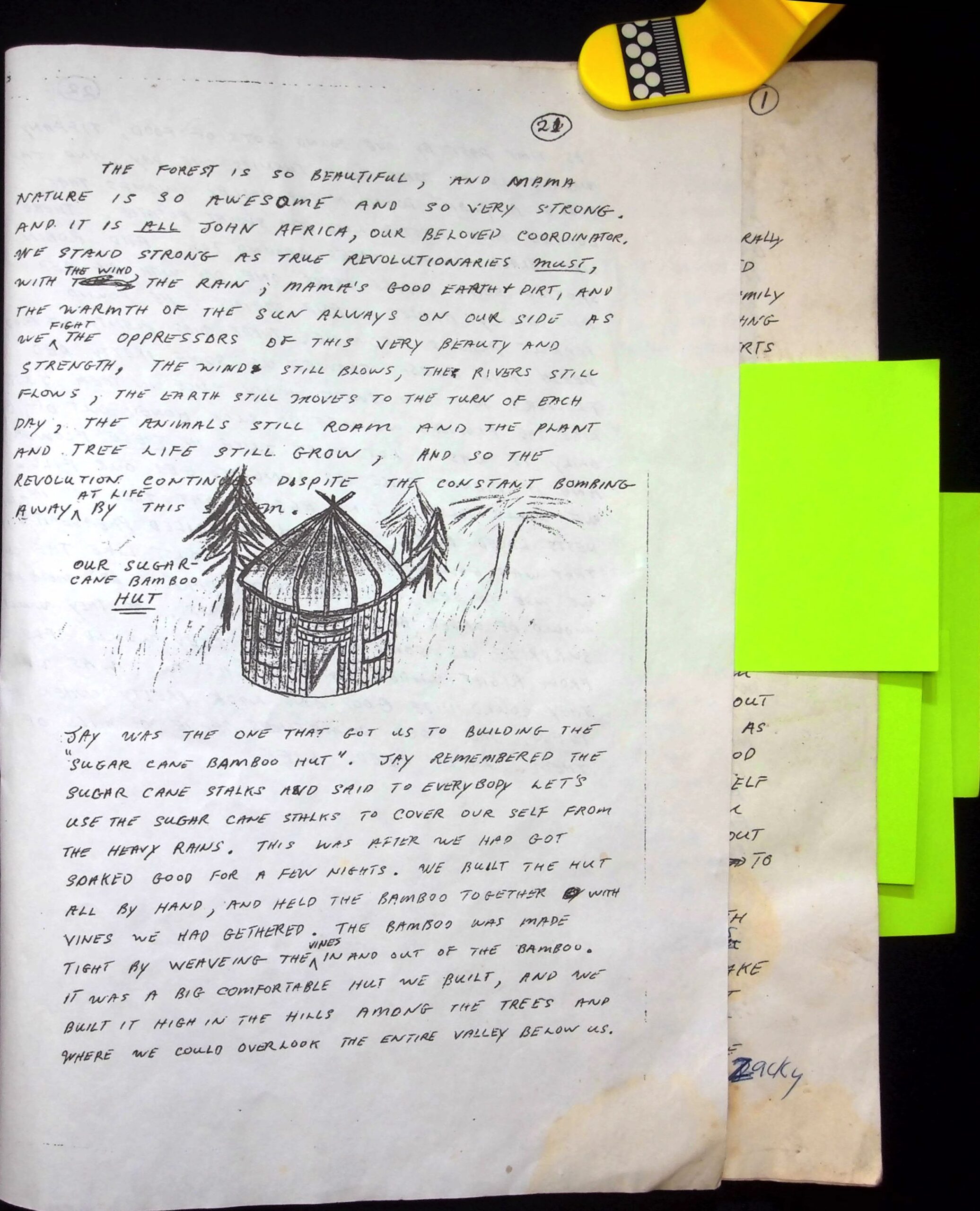
Children’s Story from Moe Africa [3]
Children’s Story from Moe Africa cont. [029c]
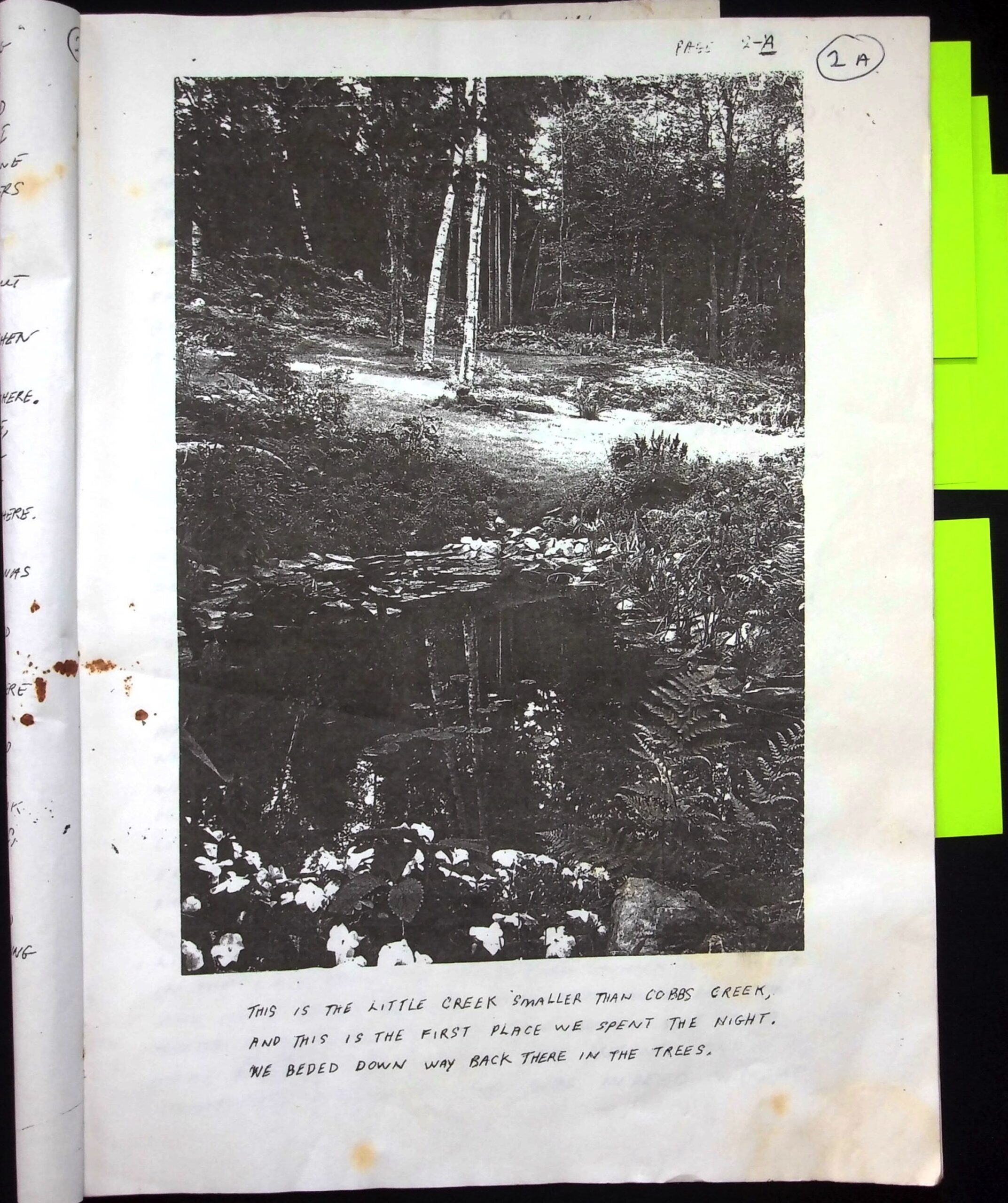
Children’s Story from Moe Africa [2]
Children’s Story from Moe Africa cont. [029b]
Tension
The tension in the Osage house carried over into the streets. John Africa/MOVE had no intention of adjusting their position on freedom for MOVE prisoners. Instead of being silenced, MOVE shouted through bullhorns strapped to their house. Instead of protesting peacefully, they used every vulgarity they could think of to describe The System’s unjust treatment of the prisoners. Instead of surrendering, they built a bunker on the roof to fortify their position in anticipation of a confrontation. As a result of MOVE not backing down and the city refusing to free MOVE prisoners that they admitted were innocent, tensions rose higher and culminated with the May 13, 1985 bombing of 6221 Osage Avenue.
Gallery
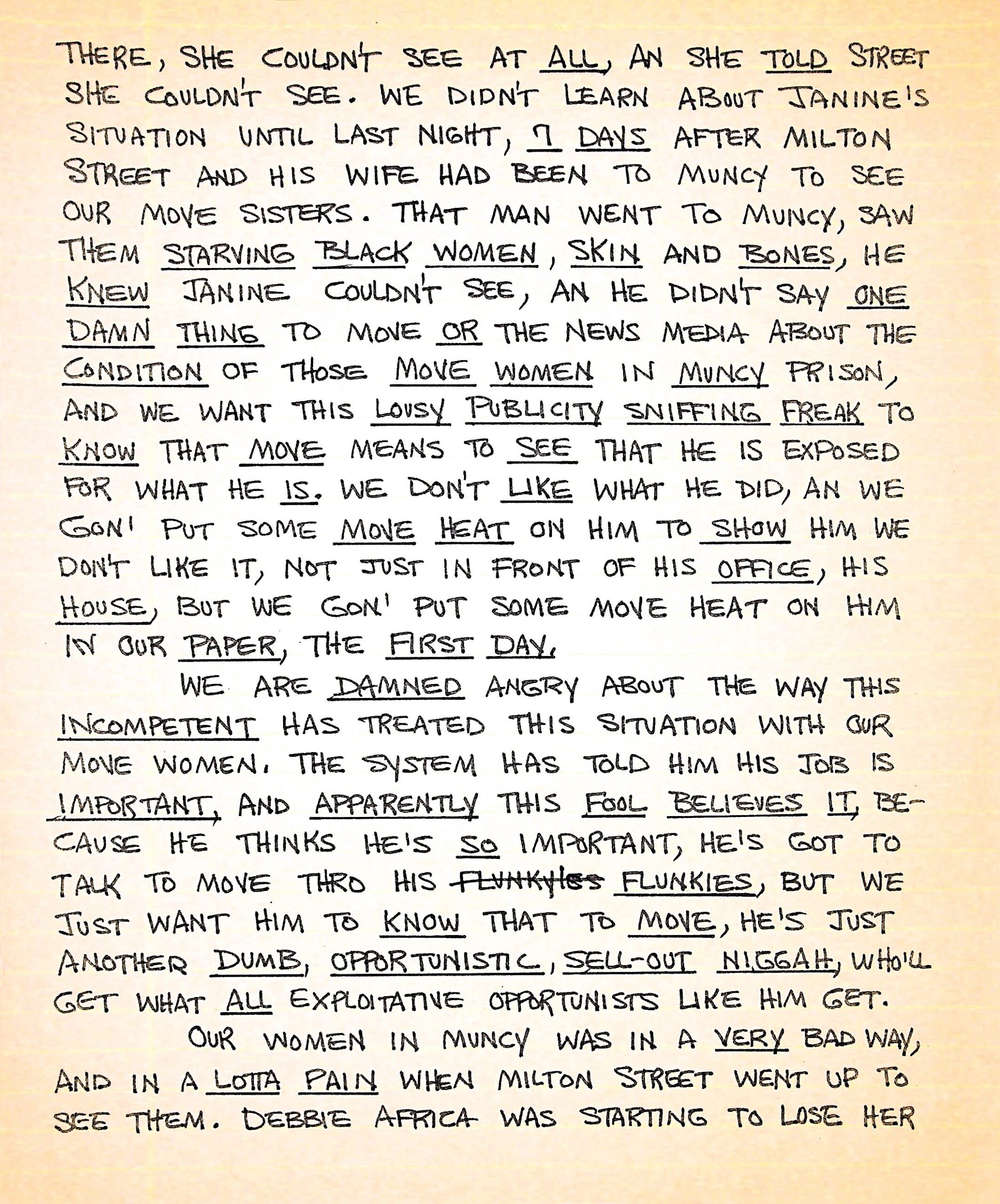
Commentary by Louise James about MOVE Women’s Hunger Strike in 1981 [1]
It is against MOVE religion to unnecessarily give blood. The rules of Muncy State Prison was that, in order to be allowed to enter into the prison population, a blood test must be performed. MOVE’s refusal to give blood forced the prison adminstration to place the MOVE women in the “Restricted Housing Unit.” MOVE staged a hunger strike in retaliation. The strike ended after 48 days when Bobby Sands of the Provisional Irish Republican Army (IRA) made world news because he died on hunger strike while imprisoned at HM Prison Maze in Northern Ireland. Fearing a repeat and martyrdom of MOVE members, Muncy guards were ordered by the administration to end the strike. Muncy officials attacked the MOVE women, subdued them, and forcibly took their blood. [033a]
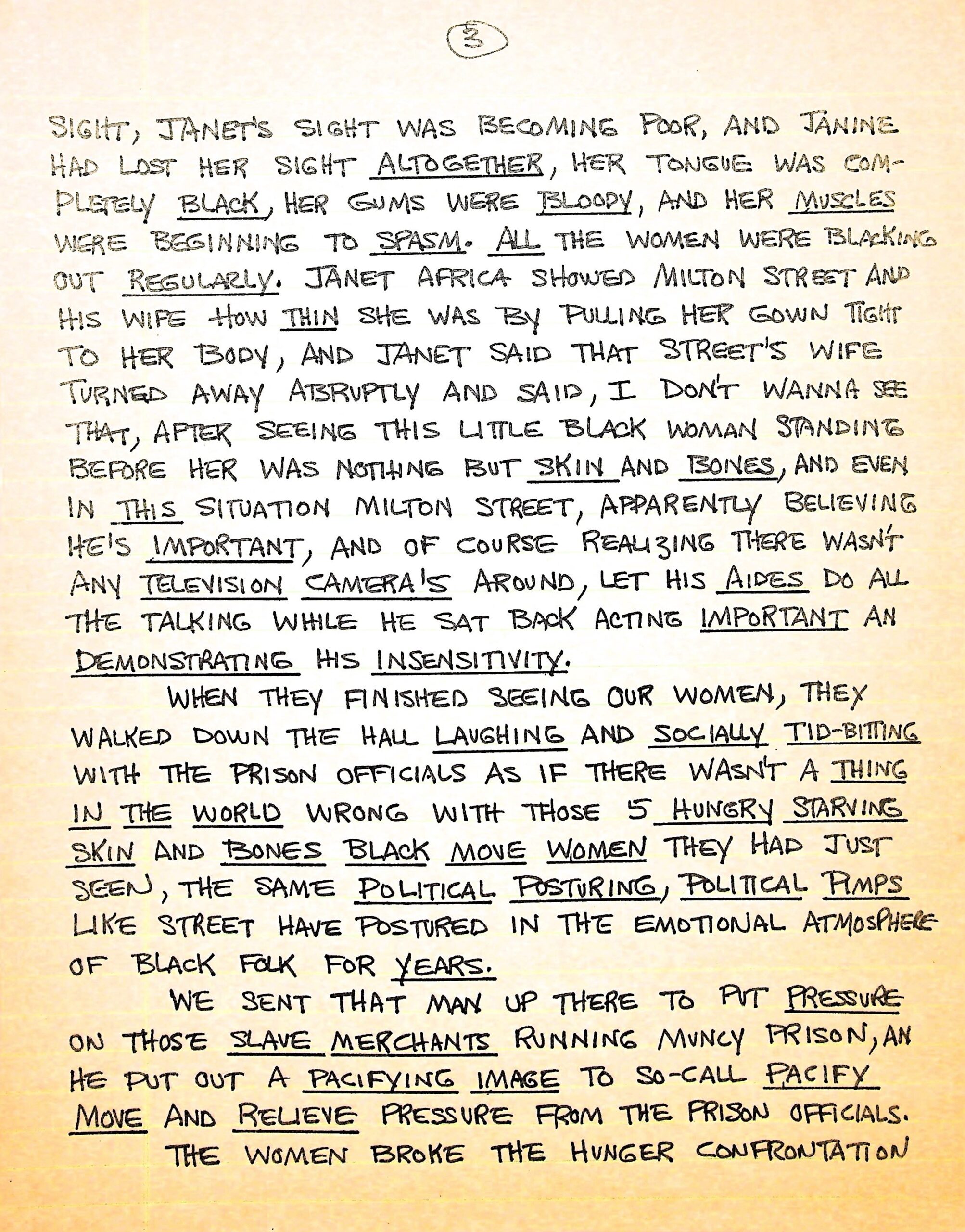
Commentary by Louise James about MOVE Women’s Hunger Strike in 1981 [2]
Hunger strike commentary cont. [033b]
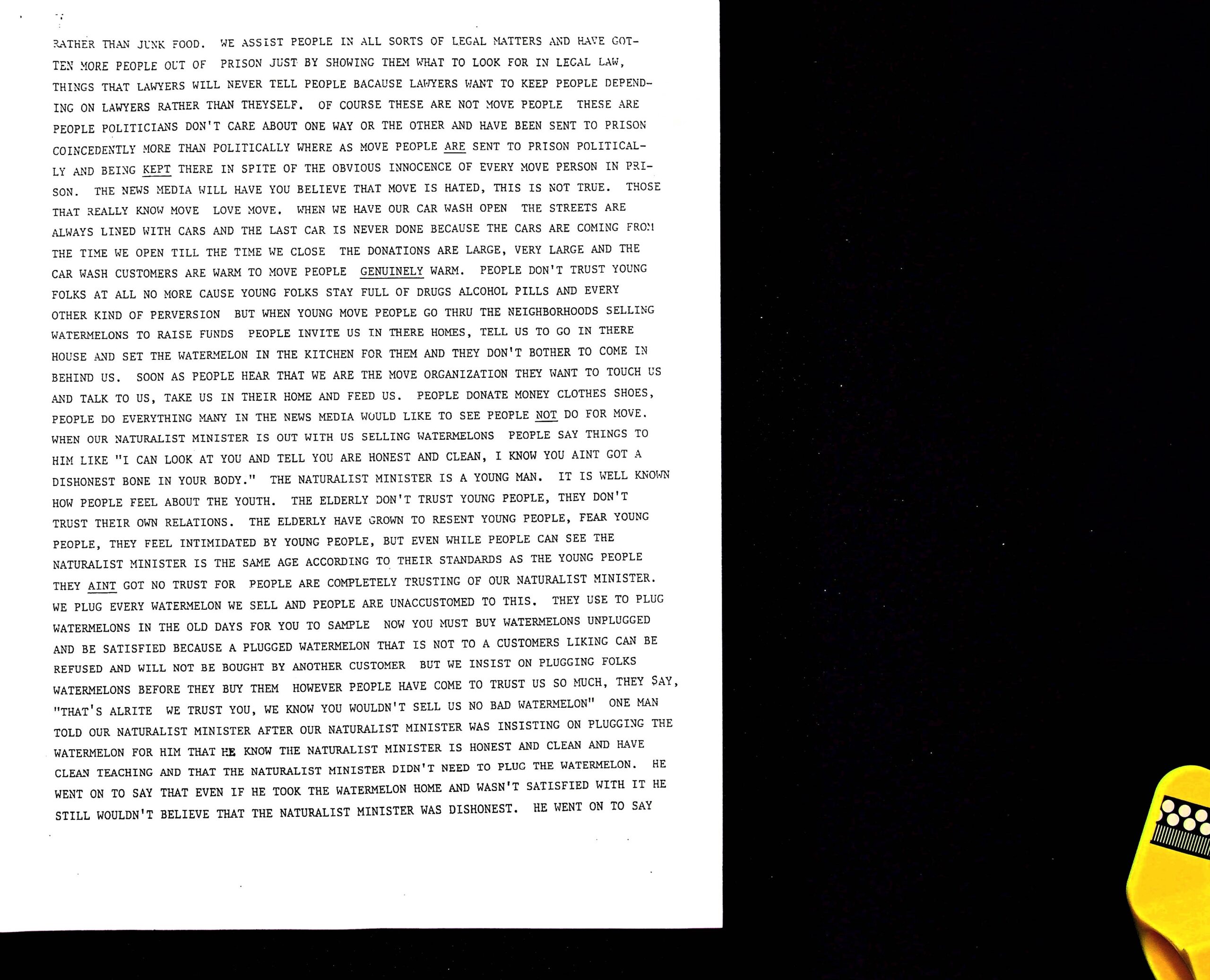
1984 Communiqué to the Public [1]
Because of MOVE’s reputation for disruption in court, disobeying law enforcement, and “violent tendencies,” MOVE struggeld to convey their message clearly to the public. This “Communiqué” was wriiten in an attempt to clear up the confusion. Prominent city figures such as community activist Novella Williams were requested to circulate the statement to the media. [036b]
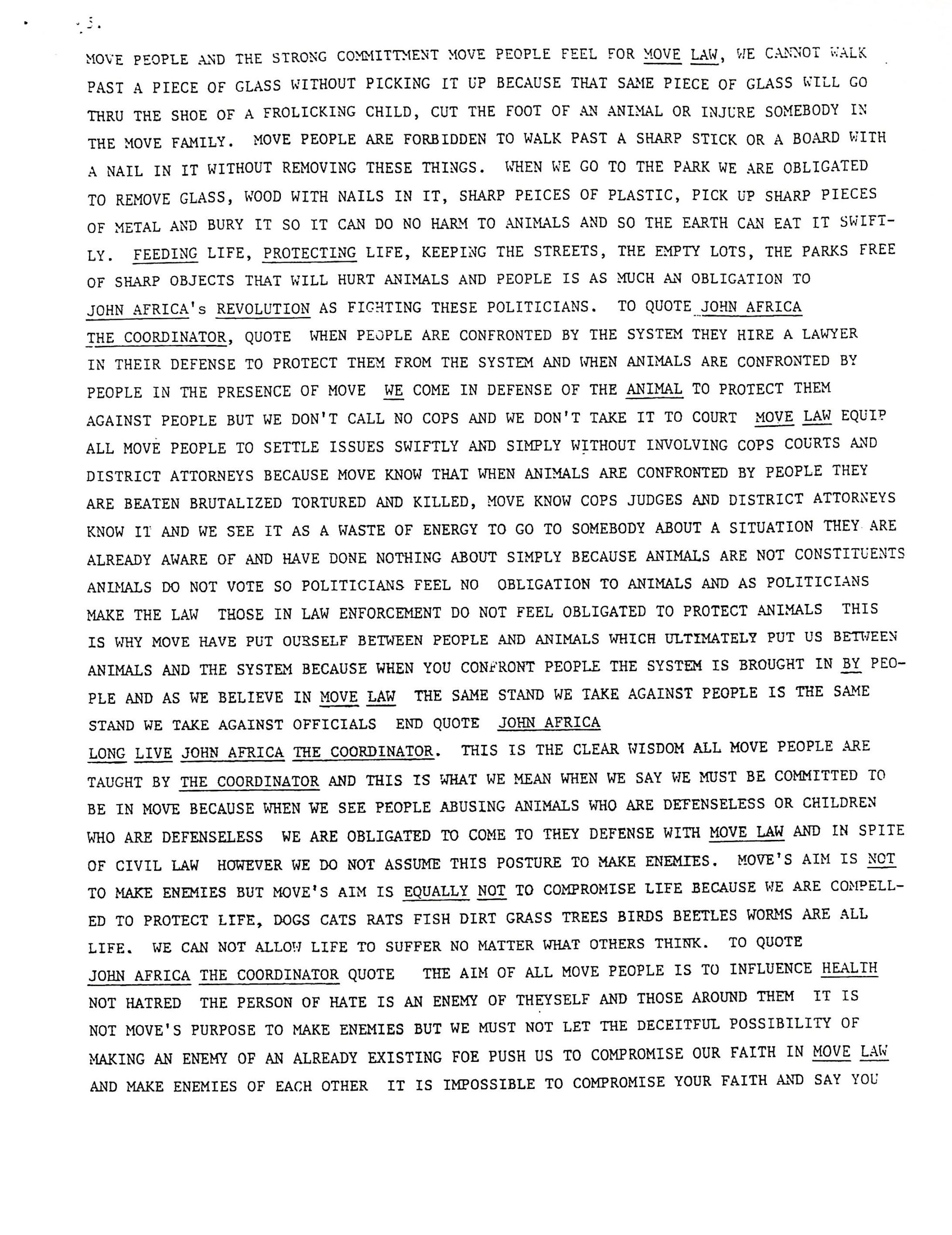
1984 Communiqué to the Public [2]
Public Communique [036b]
Confrontation
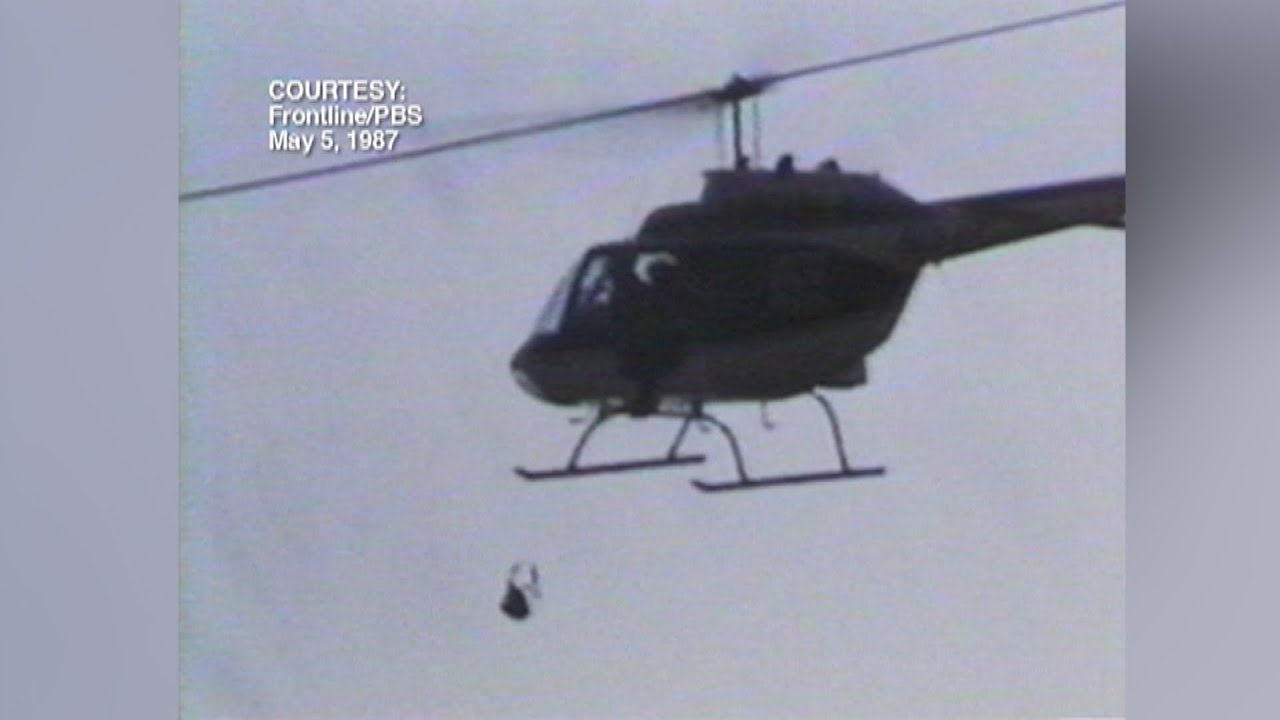
On May 12, 1985, hundreds of Philadelphia police and firefighters waged war on The MOVE Organization over the course of two days. They attacked 6221 Osage Avenue with water cannons, tear gas, and over 10,000 rounds of ammunition within 90 minutes. When that initial assault failed to drive MOVE members from the house, Lieutenant Frank Powell in a state police helicopter dropped 4 pounds of C4 on the rooftop bunker. The bomb ignited a fire, which the Fire Commissioner ordered firefighters to “let burn.” As MOVE tried to escape the fire, they were shot at by police and driven back into the burning house. Those that did escape were shot by police and their bodies were thrown back into the fire.
Gallery
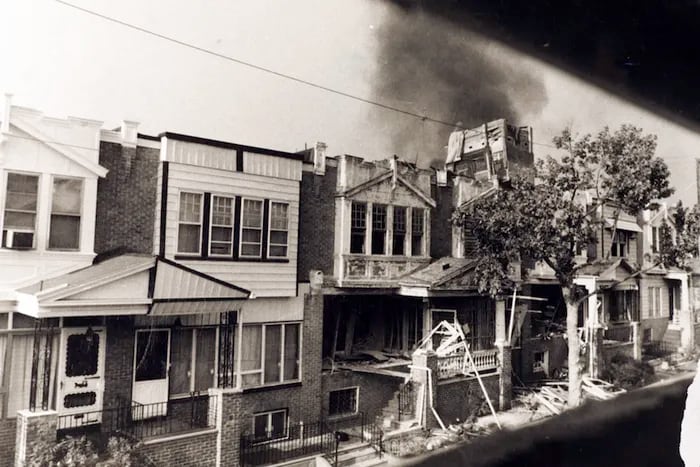
The Bunker
This image captures The Bunker, a defense post MOVE constructed on the rooftop of 6221 Osage Avenue. It created a third story to the home, towering over the neighborhood, and providing MOVE with a birds eye view of police surveillance and activity.
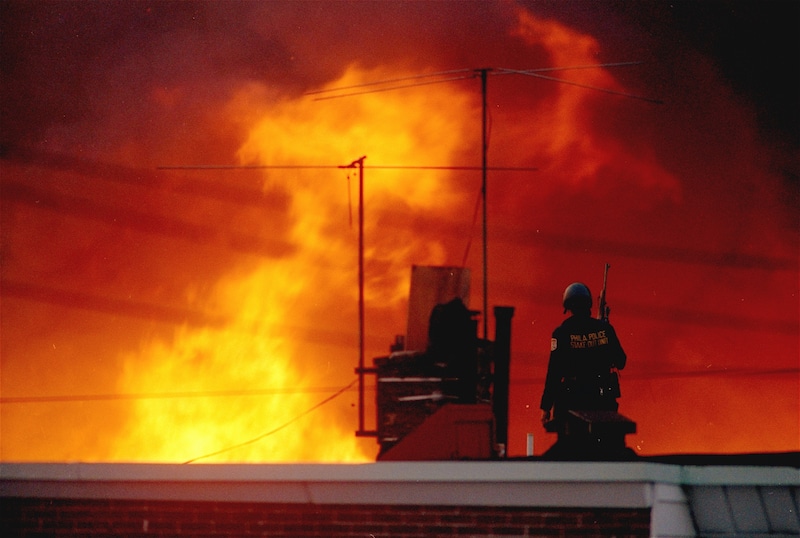
The Fire [1]
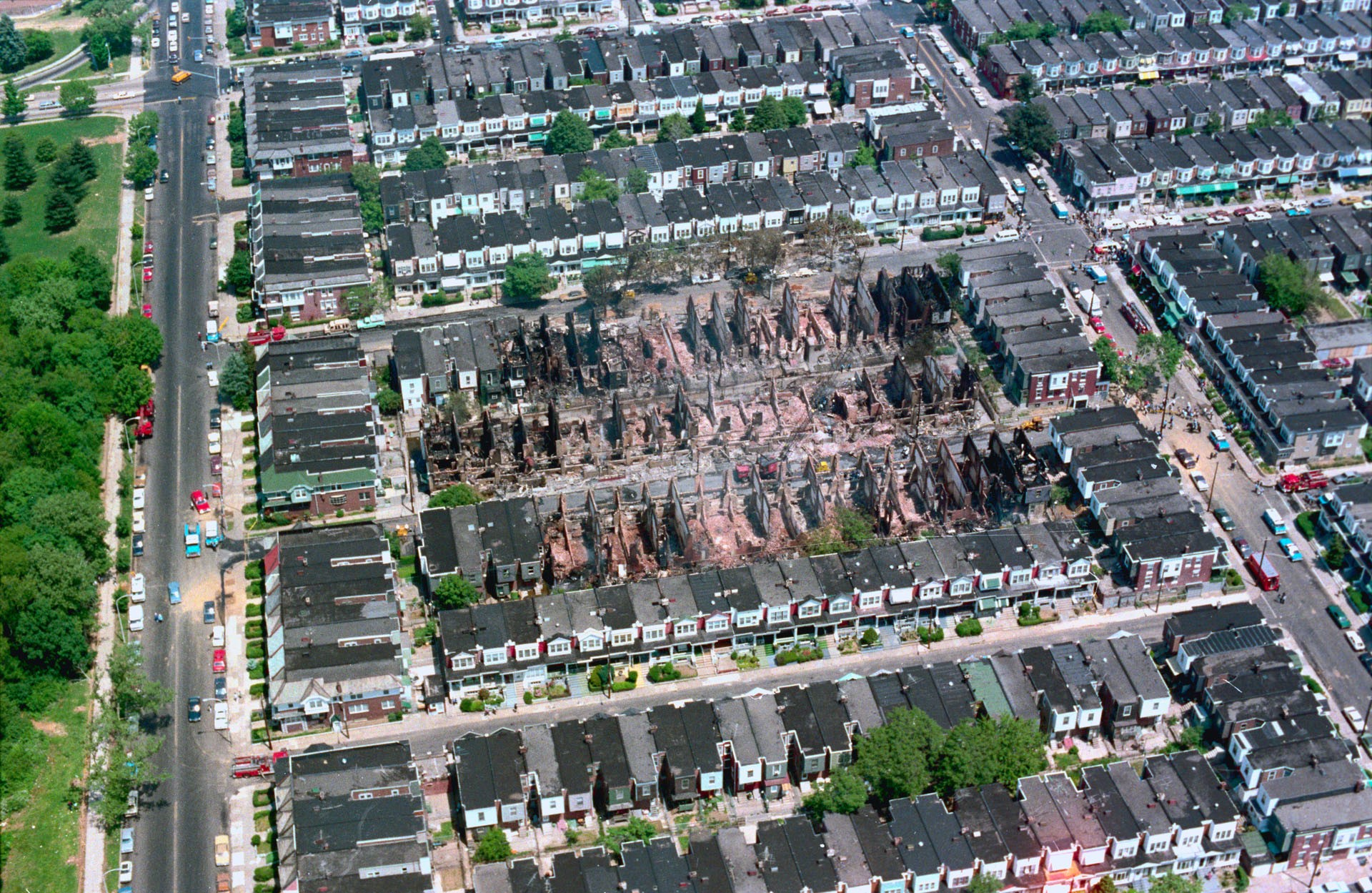
When Lieutenant Frank Powell dropped the bomb on 6221 Osage Avenue from the state police helicopter, the explosion ignited a fire that was allowed to burn by the police and fire commissioner. The fire reached a temperature of over 2000 degrees and leapfrogged across the street, igniting the other row of homes. 61 homes were burned to the ground. Two days after the bombing, ashes could still be seen falling from the sky like snowflakes. [04]
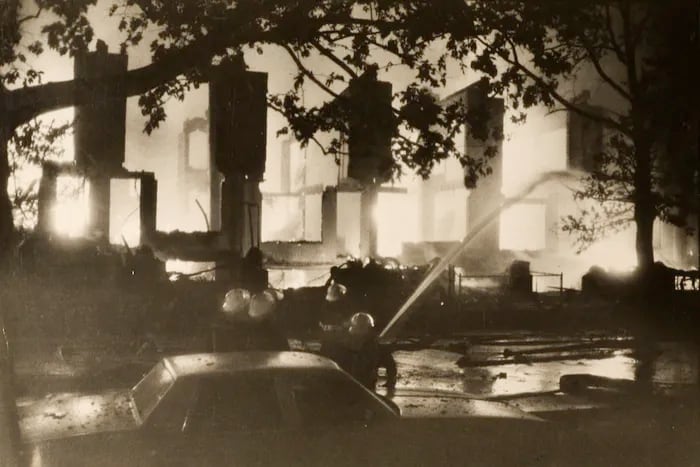
The Fire [2]
The fire cont. [05]
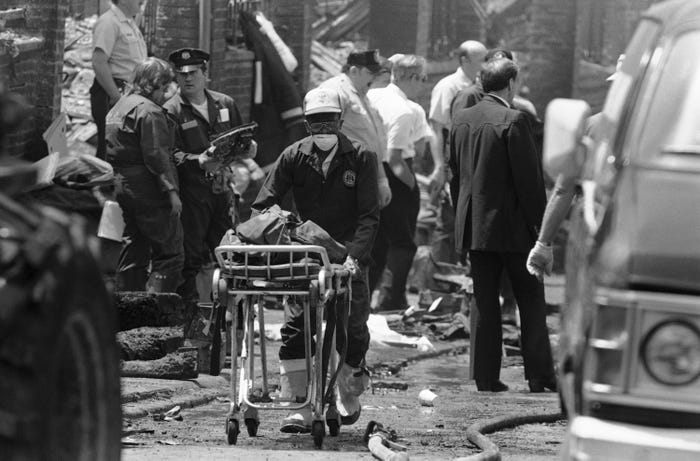
Body Bags [1]
When the smoked cleared, 11 MOVE members, including 5 children, were murdered. The body bags depicted in these images only contained parts of the murdered victims’ remains because of the carelessness with which the Medical Examiner’s Office (MEO) handled the bombing site and the theft of the remains by the MEO and subsequently the University of Pennsylvania. The whereabouts of the stolen remains have never been fully concluded. [09]
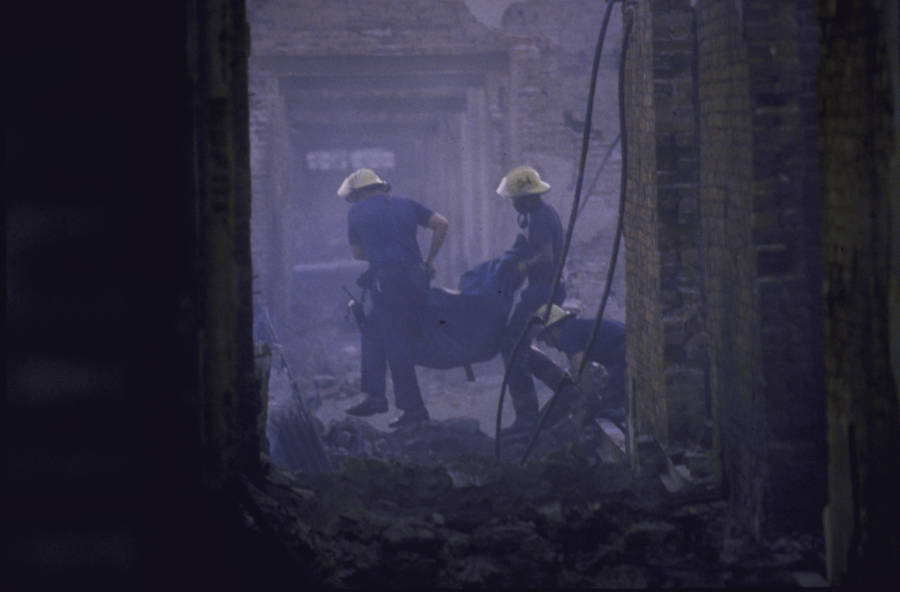
Body Bags [2]
Body bags cont. [10]
Aftermath
When the smoke cleared, 11 MOVE members were murdered. 5 of them were children. Their names are: John Africa, Frank Africa, Raymond Africa, Conrad Africa, Rhonda Africa, Theresa Africa, Tree Africa, Delisha Africa, Netta Africa, Little Phil Africa, and Tomaso Africa. There were two survivors: Ramona Africa and Birdie Africa. 61 homes across two city blocks were burned to the ground and 250 people were made homeless.
Gallery
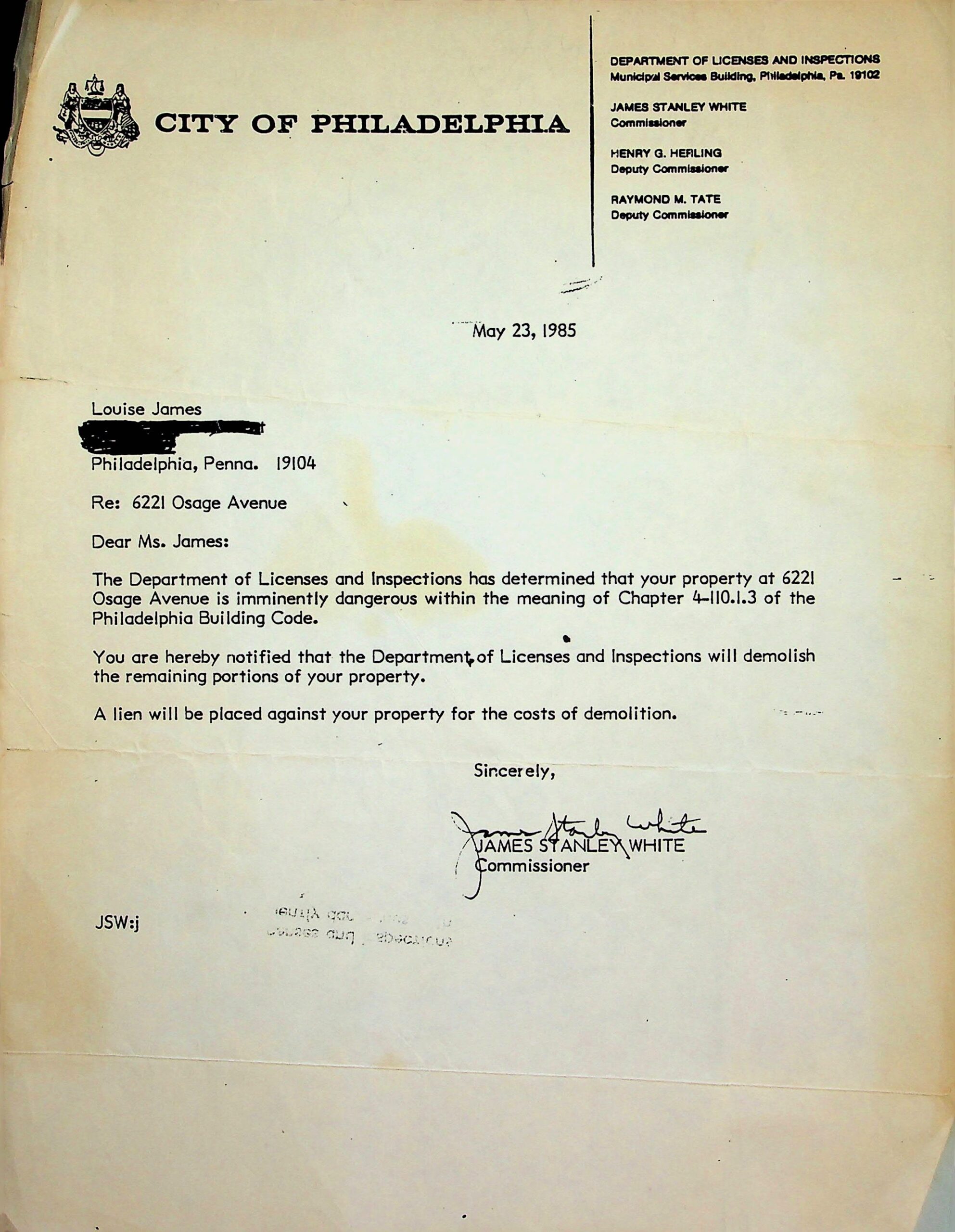
May 23, 1985 Letter from City of Philadelphia to Louise James
This letter, sent a mere ten days after the city’s bombing of 6221 Osage Avenue, communicates that the city of Philadelphia would be demolishing the property and charging Louise James for the costs of its demolition. [001]
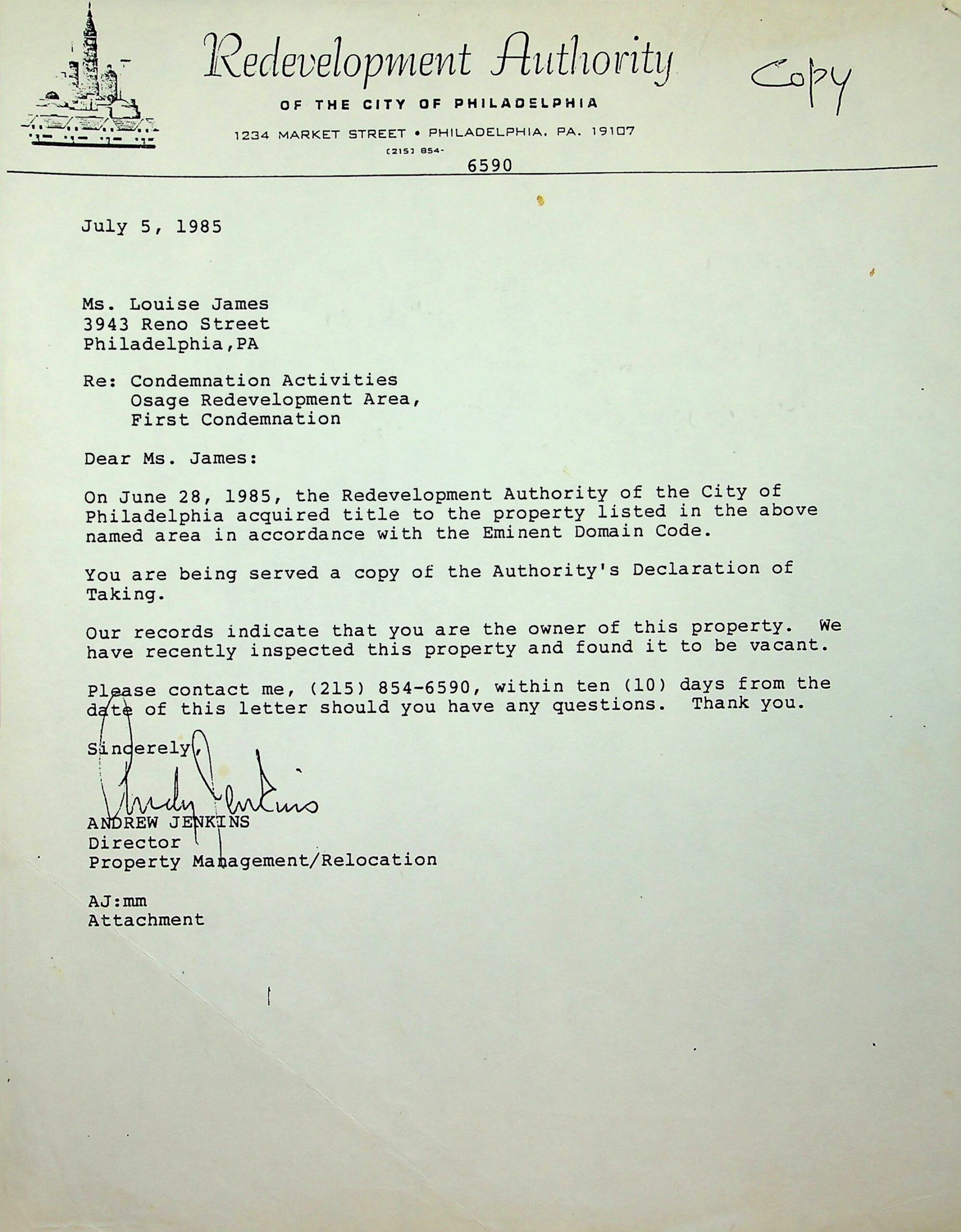
July 5, 1985 Letter from the Philadelphia Redevelopment Authority to Louise James
This 1985 letter from the Redevelopment Authority communicated that the city of Philadelphia would be seizing 6221 Osage Avenue through Eminent Domain, after bombing the property and murdering her son (Frank Africa) and brother (John Africa). [002]
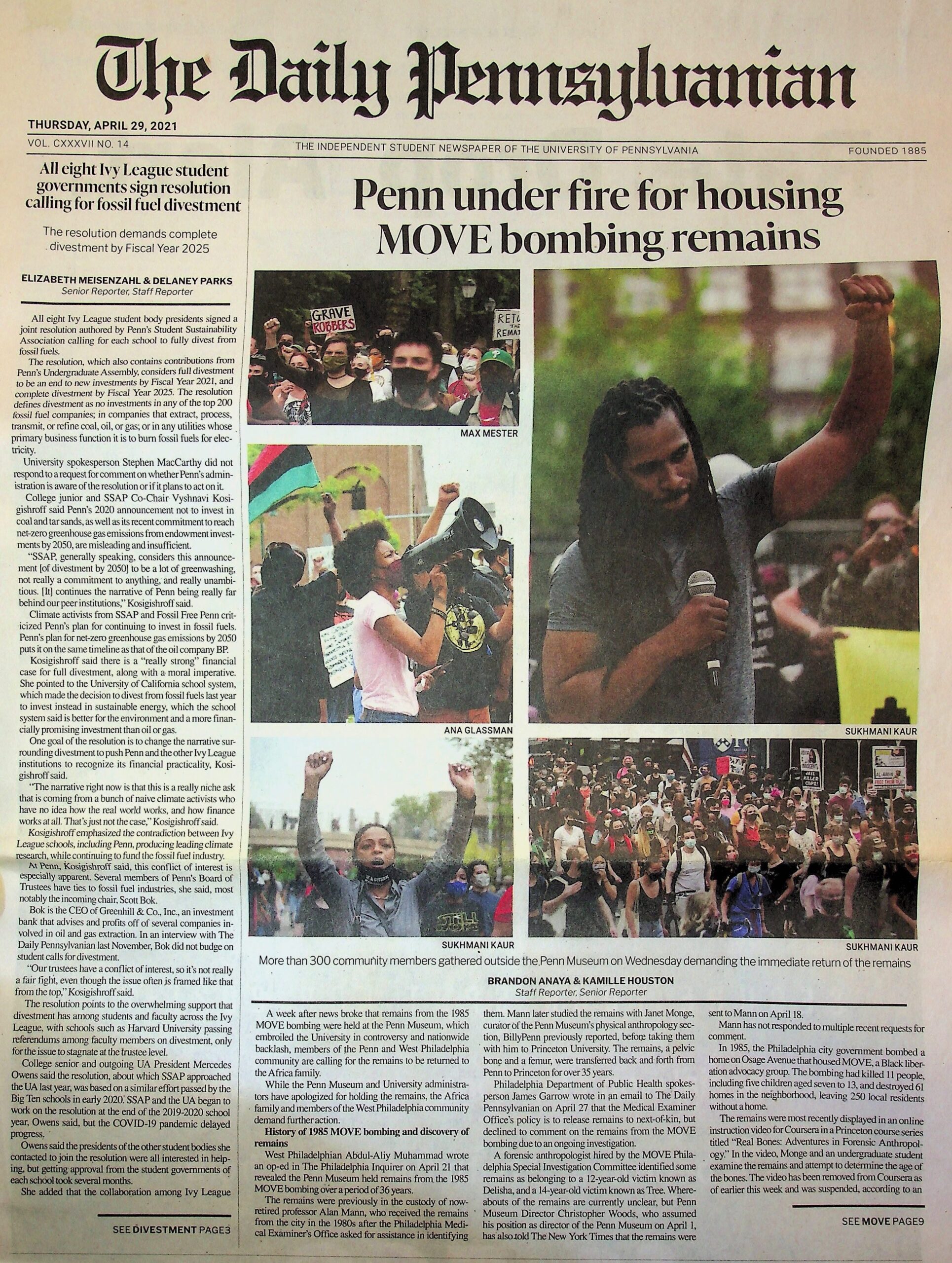
Newspaper cover story of Penn Museum theft of remains
In April 2021, MOVE learned that Alan Mann and Janet Monge of University of Pennsylvania Museum and Anthropology had stolen the remains of at least two MOVE children, Delisha and Tree Africa, after serving on the forensics team to identify the remains of victims of the 1985 bombing. On May 13, 2021, MOVE further learned that the City of Philadelphia Medical Examiner Office also retained the remains of MOVE bombing victims. This cover story of the Penn student newspaper, The Daily Pennsylvanian, reports the April 28, 2021 action in protest of Penn’s theft of the remains. [010]