
Octavius Catto Monument
Written by Safaya Smallwood

Crowd gathered in front of the Octavius Catto statue.
Located at the southwest corner of City Hall, this monument—the first and only statue on public land in the city of Philadelphia dedicated to an African American—commemorates the life and legacy of Octavius Valentine Catto.
Born a free man on February 22nd, 1839 in Charleston, South Carolina, Catto was an accomplished Black intellectual, educator, and civil rights activist during the Reconstruction Era in Philadelphia. He attended and later taught at the renowned Institute for Colored Youth, using his education to impact public policy and fight for social change for the Black community. Alongside other Black leaders like Frederick Douglass, Catto advocated for abolition and equal rights during the Civil War, playing a central role in recruiting and enlisting Black troops as well as being a huge proponent of the 13th, 14th, and 15th Amendments (abolishing slavery, granting all people born in the U.S. citizenship, and giving Black Americans voting rights, respectively.)
Catto’s accomplishments extend far beyond electoral politics, as he was a tremendous baseball player, recognized as the Jackie Robinson of his day. Faced with restrictions against joining white baseball clubs, Catto and his friends created their own African American baseball team, the Pythians. Seeking equal consideration from white baseball clubs, the Pythians fought to compete with them on the field. In this effort, Catto used his prowess on the field as yet another arena in which to advocate for racial equality, becoming instrumental in orchestrating the first interracial baseball games.
In an era where Black people faced the overwhelming realities of enslavement, discrimination, and segregation, Catto’s accomplishments across many fields, ability to envision an integrated Philadelphia, and dedication to the cause of Black liberation made him a beacon of hope for African Americans of the time.
One of the many inspired by Catto’s work was a fellow young teacher named Caroline LeCount, who shared his love of learning and passion for equality. LeCount became instrumental in enabling Black Philadelphians to ride in streetcars by filing a suit against a streetcar company for denying her a ride based on her skin color, contrary to a new law, and winning. Although LeCount and Catto were engaged, his murder prevented the two from being married. Despite this, LeCount’s affection for Catto persisted for her whole lifetime, and after his death she never married, becoming the first certified Black teacher in Philadelphia’s schools.

Rendering of the assassination of Octavius Catto.
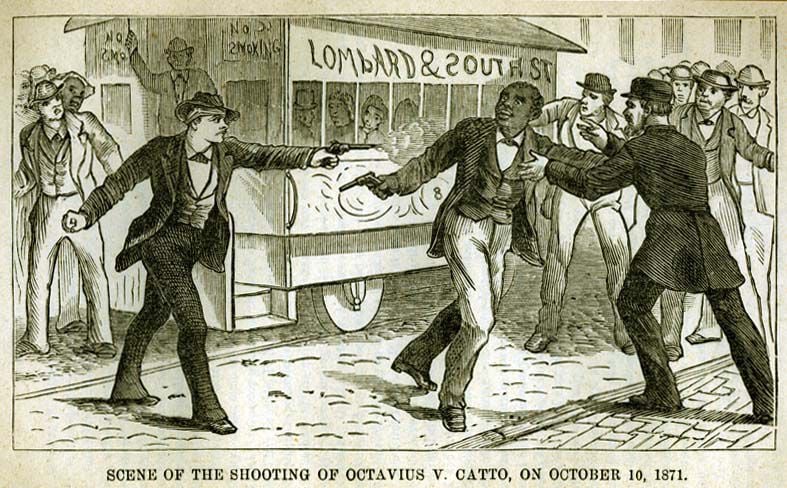
On October 10, 1871, the first election day that African Americans were able to vote—after the ratification of the 15th amendment, whose passage Catto was instrumental to—Catto went from polling place to polling place, encouraging and empowering Black people to exercise their newfound right. It was during this effort, on South Street in the historic 7th Ward, that Catto, at just 32 years old, was assassinated by white attackers motivated by the Democratic Party’s widespread anti-Reconstructionism and opposition to Black suffrage. Although he didn’t live to see the changes his leadership helped foster, Octavius Catto’s legacy as the greatest Reconstruction-era civil rights leader in the city of Philadelphia lives on.
The Octavius Catto monument, dedicated in 2018, depicts Catto in a powerful stance, mid-stride with his palms facing upward and his chest forward. Behind him, five inscribed granite blocks represent a streetcar, and he strides towards a ballot box. The monument signifies the endurance and resilience of Black Philadelphians, standing uplifted and almost defiantly opposite the now-torn-down statue of former Mayor and Police Commissioner Frank Rizzo who was renowned for his mistreatment of the Black community.

Bibliography
Cadet, Branly. “A Quest For Parity: The Octavius V. Catto Memorial.” Association for Public Art.” September, 2017.
Crimmins, Peter. “Philly Presents Long Overdue Honor to ‘True American Hero’ Octavius Catto.” NPR. 2017.
“Octavius Catto.” Airtable.
Romero, Melissa. “Philly Unveils the Long-Awaited Octavius V. Catto Memorial.” Curbed Philadelphia.” 2017.
Rothenberg, Matt. “Fighting for Equality on the Baseball Grounds.” National Baseball Hall of Fame.
“Tasting Freedom: The Life of Octavius V. Catto.” Philadelphia: The Great Experiment.
0 Comments