Malcolm X Park
Written by Isaiah Woods-Kolsky and Safaya Smallwood

Photo of Malcolm X Park bench and playground in the background.
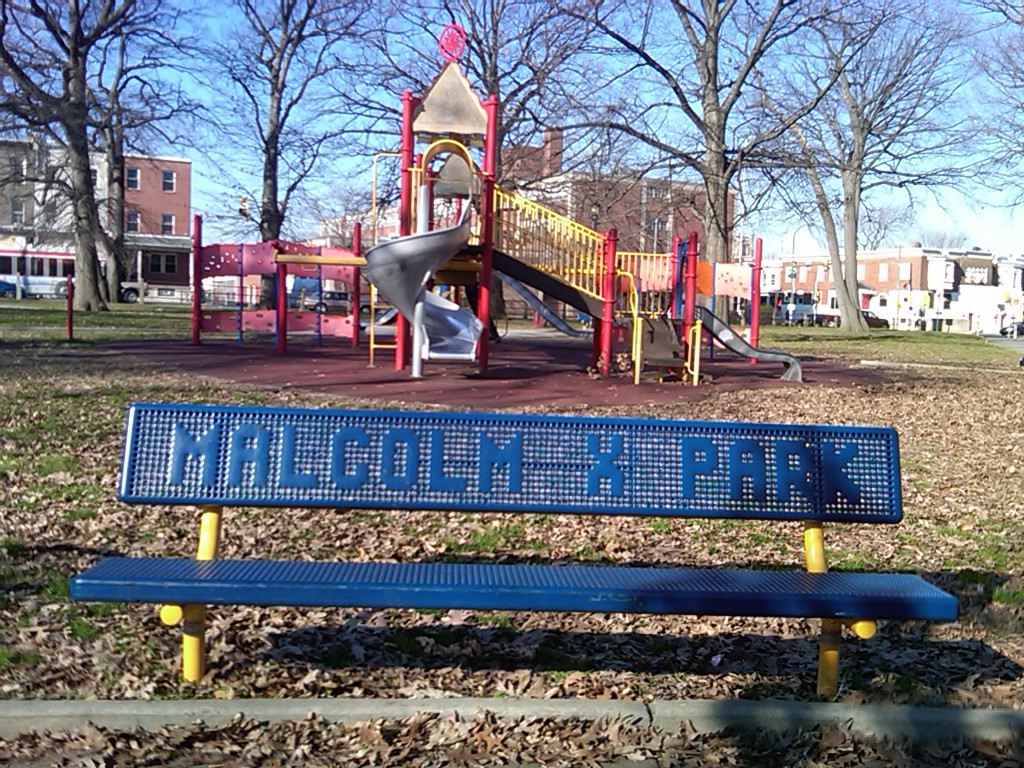
Located at 52nd and Pine Street, Malcolm X Park is a staple in the West Philadelphia Black community, holding summer festivals, the “Theater X” public theater, and political mobilizations throughout the year. However, the park and surrounding area are currently under significant threat of gentrification.
Malcolm X Park was originally named Black Oak Park. Though Black Oak Park was established in 1903, it was not accessible to the public until 1910. It would take 90 years before Black Oak Park would be renamed Malcolm X Park. For many years, Black Oak Park was referenced in real estate ads for homes, as it was marketed as a draw for people to live in West Philly. However, as Black presence grew in the park’s surrounding neighborhood, fewer ads of the park were posted because it was deemed less desirable. While both Black and white people had access to the park, Black children were forced to play in a small area of it. In fact, Gregorio Pac Colujun, affectionately known as “Brother Greg,” the current leader of the Friends of Malcolm X Park which is a group of diverse volunteers dedicated to supporting the park, recalls not being able to use the whole park as a child in the 1960s.

Image of Malcolm X Park, or Black Oak Park at the time, in 1927.

As many Black communities were impacted by the crack epidemic of the 1980s, Black Oak Park became a site of vandalism and drug activity. Yet while the park was, “seen by some as a symbol of the community’s decline, Black Oak Park became a catalyst for community uplift.” Members of the neighborhood who cared about the well-being of the park sought to clean it up in an effort to restore the park to what it had once been, transforming it into a community-building space. One historical example of this community building was the African Liberation Day parade on May 28, 1988, which started and ended at Black Oak Park and whose parade route included the block of Osage Ave, where the 1985 Bombing of MOVE occurred. African Liberation Day parades are held annually in cities around the U.S.
In early 1993, several community leaders called for the park to be renamed and in October of the same year, Black Oak Park was officially renamed to Malcolm X Park. A few years after the park’s renaming, conflict returned as the establishment of alcohol stores in the neighborhood increased drinking in the park. The efforts made by the community just a couple of years before seemed to be going to waste. However, the Friends of Malcolm X Park worked actively to make the park thrive, and in 2001 they received funds totaling $500,000 in support of this mission. As a result, a gazebo, cornerstone, new benches, bathrooms, pathways, and a playground were built.
Today, if you walk through the park you are guaranteed to see many families spending time in it. However, it is important to note that in recent times the surrounding community has experienced significant change due to gentrification. In a WHYY article, “Between 2000 and 2016, West Philadelphia’s Black population decreased by 35% as rents rose and home prices jumped.” Displacement is particularly high in the area surrounding Malcolm X Park. The same members of the community who fought to make Malcolm X Park better are now being forced to leave. Thus, the fight is never over, which is why we must always ALWAYS be on a MOVE!
Bibliography
Allen, Taylor. “Report: West Philadelphia Renters Face A Growing Risk of Displacement.” WHYY. 2020.
Homan, Spencer. “Malcolm X’s Philly Roots Run Deeper Than You May Think.” The Spirit. 2016.
Lee, Nathaniel. “Sweet sounds now emanating from West Philadelphia Jazz Heritage Series.” The Philadelphia Tribune. 2016.
“Malcolm X Park Gets A New Mural.” NBC 10 Philadelphia. 2016.
Williams, Mariam. “A Brief History of Race and Contested Space In West Philly.” Hidden City. 2018.
0 Comments