
Church of the Advocate
Written by Justin Acheampong

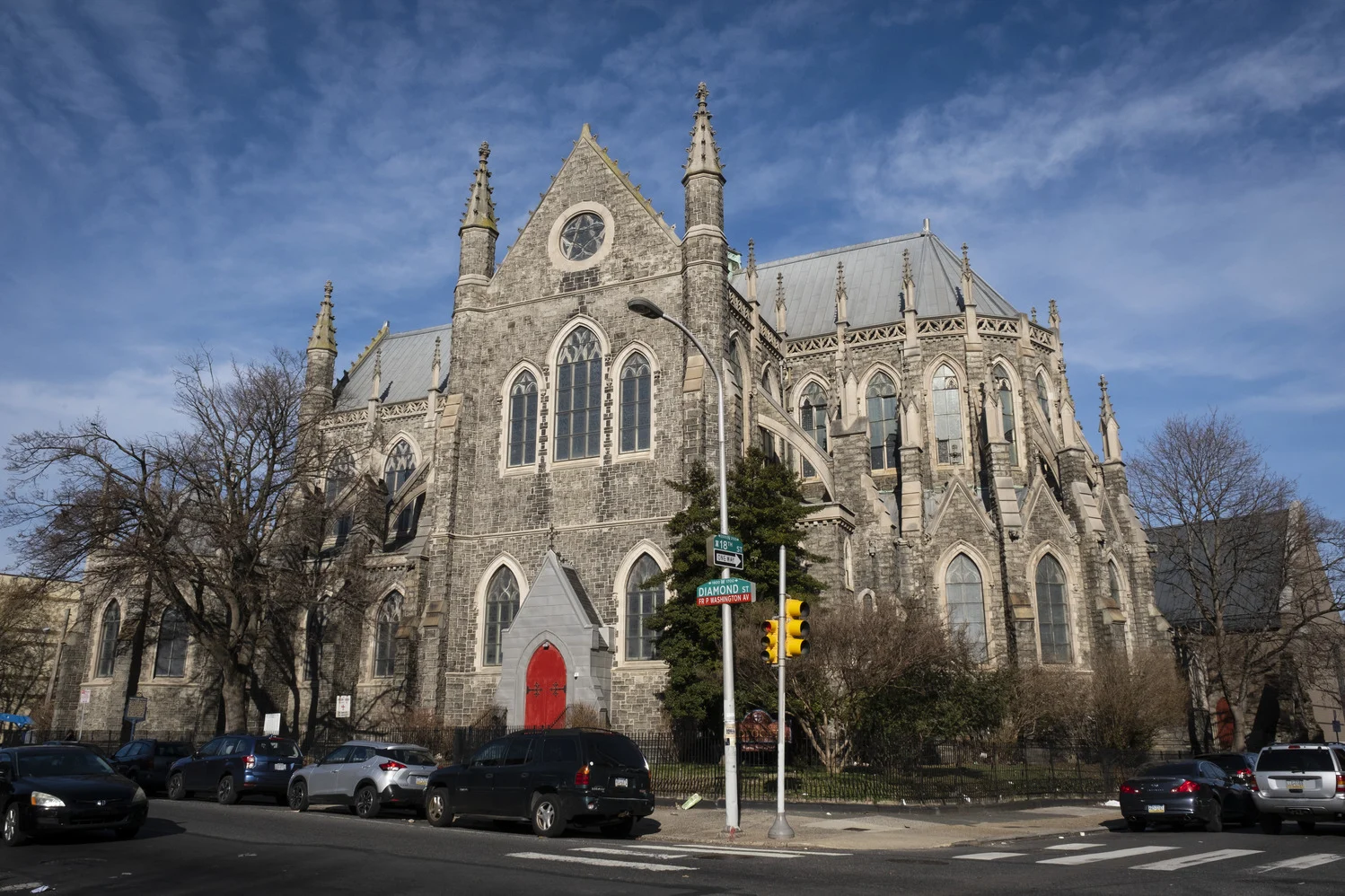
The Church of the Advocate lives the gospel of Christ and is a welcoming community dedicated to spiritual enrichment, human services, community programs and the pursuit of social justice.
–The Church of the Advocate Mission Statement
Located in North Philly at 1801 W. Diamond Street is the Church of the Advocate, an Episcopal church with a rich history of social justice. Founded to be “the church of every man,” this site has done much to support the Black community that surrounded and worshiped within it, starting with ending the tradition of the renting of pews, and making worship financially accessible to everyone.
The church’s national ascension into a center for Black resistance and social justice work was headed by Paul M. Washington, the rector of the church between 1962-1989, and one of the few Black priests in a traditionally White church. An advocate for Black Power and a supporter of the Black Panthers, Father Washington was a believer in the power and importance of Blackness and sought to emphasize that within the Church of the Advocate, especially as Black community members began showing frustration at the lack of representation within the predominantly White church leadership, symbols, and sermons. Washington worked to address this and reconnect the Black churchgoers to the space; in 1973, he commissioned two Black artists, Richard Watson and Walter Edmonds, to create 14 murals depicting the Black experience in America, including slavery, emancipation, and scenes from the Civil Rights movement. Each mural has a Bible verse associated with it, located under the painting, that is meant to relate the images and experiences of Black people to the Bible and help the Black community see themselves within the Bible verses and religion in order to combat Eurocentrism within Christianity. The murals have become a key aspect of the church, with Father Washington referring to these murals as depicting the “suffering and the anger, as well as the strength and dignity of the African-American.”

Image of one of the murals at the Church of the Advocate.

In addition to centering the need for Black representation and connection to the church, Washington also took on the historic role of Black churches in social justice and resistance work. Through opening the doors to the church to the Third Annual Conference of Black Power in 1968, to the Black Panther Conference in 1970, and to the rally for the Angela Davis Defense Fund in 1971, the Church of the Advocate became a pillar for important events in Philadelphia’s Black Power and liberation movements. Hosting these events skyrocketed the church into notoriety as a place for equality and progress. In addition, Washington led the church to be an advocate for many other marginalized communities, including the poor, the dispossessed, the oppressed, women, and the LGBTQ+ community. In terms of Women’s Rights, the church, under Washington, ordained the Philadelphia 11 in 1974, a group of White women who wanted to become priests at the church, but due to sexist rules, they were prohibited. Washington welcomed them with open arms and allowed them to become priests at the Church of the Advocate despite pushback from Episcopal leadership and threats to pull funding. Washington and the church set a huge precedent for the Episcopal system, with Episcopal leadership officially allowing women to become priests two years later.
To this day, the Church of the Advocate remains a pillar in Philadelphia for social justice. “It organizes youth programs that support the arts, sports and academic pursuits. It houses a soup kitchen that helps feed local residents in need with several meals a week and has a hand with several other charitable endeavors” throughout the city. They also provide legal sanctuary to immigrants who are in need.

Image of one of the murals at the Church of the Advocate.

Bibliography
“Church of The Advocate.” Church of the Advocate.
“Leadership Gallery.” The Archives of the Episcopal Church.
Sly, Margery. “The Church of The Advocate.” History News. 2021.
“The Church of The Advocate: Church of The Advocate.” PhilaPlace.
0 Comments