Columbia Avenue
Written by Justin Acheampong


“The North Philadelphia riot served as a metaphor for the lack of connection that many of the city’s black poor felt to both the national and local leadership of the civil rights movement.”
“It was, however, the explicitly racial nature of the riot that was its most significant challenge to liberalism. By venting their anger on white police officers and white-owned business– and by sparing black-owned businesses– the rioters articulated a demand not for equal treatment but for the exclusion of white wealth and power from their neighborhoods.”
– Matthew Countryman, “Up South: Civil Rights and Black Power in Philadelphia”
Columbia Avenue, located in North Philadelphia, runs east to west between Delaware Avenue and 33rd Street. The portion of Columbia Avenue from 33rd Street to Frankford Avenue is named Cecil B. Moore Avenue.
Columbia Avenue connects a community with a deep history of Black culture and Black resistance. From the 1940s-60s, Columbia Avenue was nicknamed “The Golden Strip” of North Philadelphia, named so for the fact that it served as the heart of the jazz scene in the city. This street served as the lifeblood for Black people in terms of nightlife as well as music, with upwards of 15 venues existing on the street. One such venue was named Watts Zanzabar, one of the few Black-owned nightlife venues, owned by brothers Richard and Robert Watts. It was recognized by noted author and scholar James G. Spady in his essay “Lost Shrines of Jazz” as the home for “modern African American culture” at the time, with it being regarded as most responsible for Philly’s bebop revolution. To this day, there are annual jazz celebrations on Columbia Avenue, like the “Jazz on the Ave” event.

Flyer for the 2018 annual “Jazz on the Ave” event on Cecil B. Moore Ave.
During this time, Columbia Ave was a focal point of both Black culture and joy. However, things started to get harder for the residents living in this community for a few reasons. Columbia Ave, in addition to other areas of the city, experienced high rates of violence at the hands of the police. In addition, as the White flight and deindustrialization of the 50s and 60s destabilized many Black people’s livelihoods, “urban renewal projects” (what we would now refer to as gentrification or forced displacement and disinvestment) swept in to do more damage. These projects caused devastating changes to the area like relocating Black families out of their homes, demolishing businesses, and raising the cost of living in favor of White entrepreneurship and wealthier residents. In addition, racism within the housing and loan systems (i.e. redlining, blockbusting, etc.) further disadvantaged Black people on Columbia Avenue and continued the impoverishment of this cultural hub of the city.
However, the working class of Columbia Avenue and North Philadelphia would not take these injustices to their community lightly— they acted and mobilized to confront White Supremacy directly. Under the leadership of Cecil B. Moore, the most influential protest and civil rights leader in Philadelphia— especially for working-class Black people —citizens of the community would work to combat the destabilization of their community (it is for Moore’s role as a prominent civil rights leader, protestor, and someone who tried to calm the Race Riot of 1964 that he had a section of Columbia Ave named after him). Abandoning the more passive and nonviolent methods of Black liberals in the city, since their tactics failed to better the conditions of the working class, residents of Columbia Avenue adopted tactics more aligned with the Black Power movement and southern tactics of protest that were all-Black and used more confrontational and language and approaches (Up South). The organizing and mobilizing of Columbia Avenue and North Philly led to big wins for the area and the city at large— protests against the discriminatory hiring practices of construction companies in the area led to more Black people being hired and President Kennedy taking notice and implementing an Affirmative Action-based Executive Order to help desegregate the construction industry (Up South).

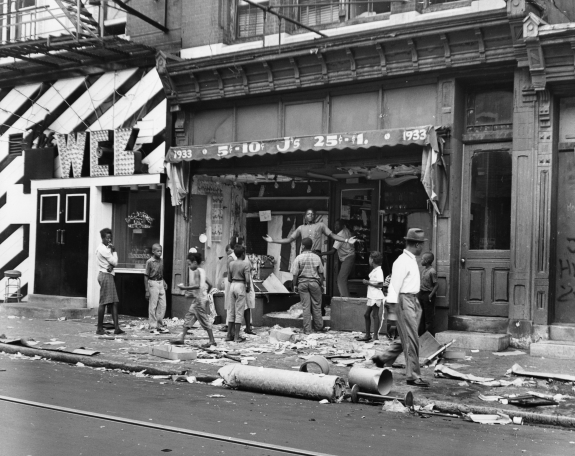
Columbia Avenue’s ability to mobilize was truly shown in 1964 during the August 28-30th riots. After years of enduring police brutality in their community and throughout their city, the residents in this community had had enough. Less than a year prior, the fatal murder of an unarmed Black man named Willie Philyaw at the hands of the police sent the community into action, with a group mobilizing by throwing bricks and expressing their frustration with the police (Up South). On August 28th, rumors spread of the police murder of a pregnant Black woman named Odessa Bradford, and the community, still reeling from another murder less than a year before, sprang into action. While the rumors turned out to be false and in actuality, Odessa was unnecessarily and roughly pulled out of her car for blocking an intersection, the community mobilized within just 2 hours, with hundreds of people taking to the street (Up South).
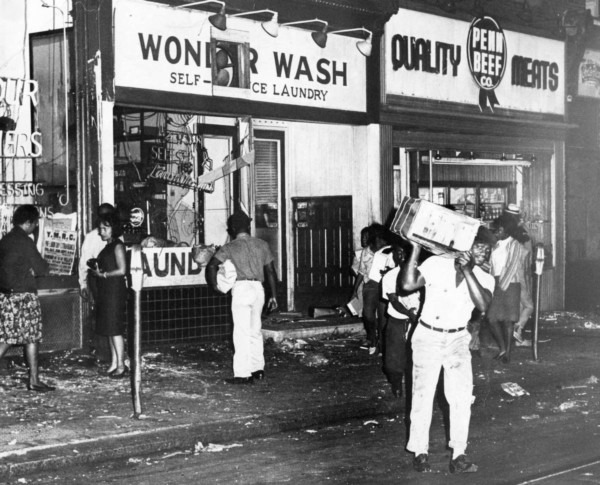
With a group of majority women and young people (teenagers or younger), showcasing the power of Black women and youth mobilizers, protestors took to bricking and flipping police cars, chanting in the streets, and damaging White-owned businesses in the area (Up South). Reverberating throughout the area were chants of “We want freedom”, a woman who stated, in response to Cecil B Moore trying to calm the riot “Listen, man, this is the only time in my life I’ve got a chance to get these things”, with another woman saying “We don’t need Cecil Moore… We don’t need civil rights. We can take care of ourselves” (Up South). All these quotes represent the push for freedom from White Supremacy, how jaded the community felt by the liberalism of protests and demands for change that compromised the wellbeing of their communities, and a reclamation of their Columbia Ave. After the 3 days of rioting from August 28th-30th, 54 of 172 businesses remained unharmed, with 52 being Black-owned businesses, 1 Chinese restaurant, and 1 abortion clinic (Up South). The people of Columbia Avenue sent a message to their oppressors – they said we will not sit by and let you take our community from us; we will FIGHT.

It is this history of both Black culture and Black resistance that makes Columbia Ave/Cecil B. Moore a linchpin in Black Philadelphia history and a place deserving of much celebration and remembrance. Its important position within North Philadelphia and the city at large is the reason why the UNIA and Black Panthers would both have their Philly bases on that street. Despite this community’s essential role in Philadelphia, gentrification and university encroachment, specifically by Temple University, are currently changing the landscape of this historic street. However, amazing community organizers are continuing to fight the gentrification and preserve this hub for Black people.
Read this article to hear more about the gentrification of Columbia Ave./North Philly and what you can do to help combat it.
Bibliography
Anderson, Faye. “All That Philly Jazz.” All That Philly Jazz. 2022.
Anderson, Faye. “Watts’ Zanzibar.” All That Philly Jazz. 2015.
“Columbia Avenue.” All That Philly Jazz. 2017.
“Columbia Avenue.” Temple University Libraries.
Countryman, Matthew. “Up South: Civil Rights and Black Power in Philadelphia.” University of Pennsylvania Press. 2007.
Gans, Herbert J., et al. “The Failure of Urban Renewal.” Commentary Magazine. 2015.
Gaspaire, Brent. “Redlining (1937-).” BlackPast. 2012.
Gaspaire, Brent. “Blockbusting.” BlackPast. 2013.
Jewett, Marilyn Kai. “Commentary: North Philadelphia Residents Fight For It’s Future, Call To Stop Gentrification and Displacement.” Generosity. 2021.
Wallace, Ethan, et al. “Ruminating on Lost Columbia Avenue.” Hidden City Philadelphia. 2014.
Waring, Charles. “What Is Bebop? Deconstructing Jazz Music’s Most Influential Development.” UDiscover Music. 2022.
“Welcome to BlackPast.” BlackPast. 2022.
0 Comments