
6221 Osage Avenue
Written by Safaya Smallwood
On May 13th, 1985, this West Philadelphia location—6221 Osage Avenue in the Cobbs Creek neighborhood—was the site of an appalling act of state violence that resulted in the tragic deaths of 11 MOVE members. It was at this place that the legacy of the city would be forever entangled with horrific violence, and Philadelphia earned its reputation as “the city that bombed itself.”
After the 1978 confrontation between MOVE and police at the MOVE Headquarters at Powelton Village culminated in the death of an officer and the unjust arrest and subsequent charging of the MOVE 9 for the crime despite evidence to the contrary, tensions between MOVE and the Philadelphia Police Department continued to grow. Fixated on revenge and eliminating MOVE at any cost, the City of Philadelphia and the Philadelphia Police Department planned and strategized for years, preparing for another assault on the organization. On the sixth anniversary of the 1978 confrontation, in 1984, hundreds of police and firemen swarmed Osage Avenue in what appeared to be a dress rehearsal for another assault.
Media attention on the situation focused on disputes between MOVE and neighbors rather than the ongoing conflicts between MOVE and the corrupt system. By May of 1985, the tensions came to a head, with police fixated on a show of force and neighbors appealing to the governor for action. With the whole city watching, Philadelphia’s first black Mayor, Wilson Goode, prepared for a final show of force to silence MOVE.
Despite efforts on the part of MOVE spokesperson Jerry Africa to negotiate a de-escalation of tensions, the city refused to initiate a just investigation of 1978 or to refute claims of improper legal procedures. On Sunday, May 12th—Mother’s Day—police evacuated the 6200 block of Osage Avenue, assuring residents that they could return by Monday evening at the latest. Despite directions from the Mayor that any MOVE children outside the house should be taken into custody, officers allowed a car openly carrying MOVE children to the house past the barricade.

Police helicopter dropping a C-4 explosive on the MOVE rowhouse.
/cloudfront-us-east-1.images.arcpublishing.com/pmn/PGLPNLEASFBI3LPEEMAH4KKDTQ.jpg)
On Monday, May 13th, 1985, Philadelphia police and firemen launched a military-style assault on the MOVE row house. Leading the assault, Police Commissioner Gregore Sambore proclaimed over loudspeaker, “Attention MOVE: This is America!” Using tear gas, water cannons, and a wide array of military weapons including M-60 machine guns, a 50-caliber machine gun, and a 20mm anti-tank gun, police attacked the house, firing over 10,000 rounds of ammunition between 6:00 and 7:30 AM at a house known to contain women and children. They lobbed blocks of military-grade explosive C-4 at the house, blowing the front porch of 6221 into the street.
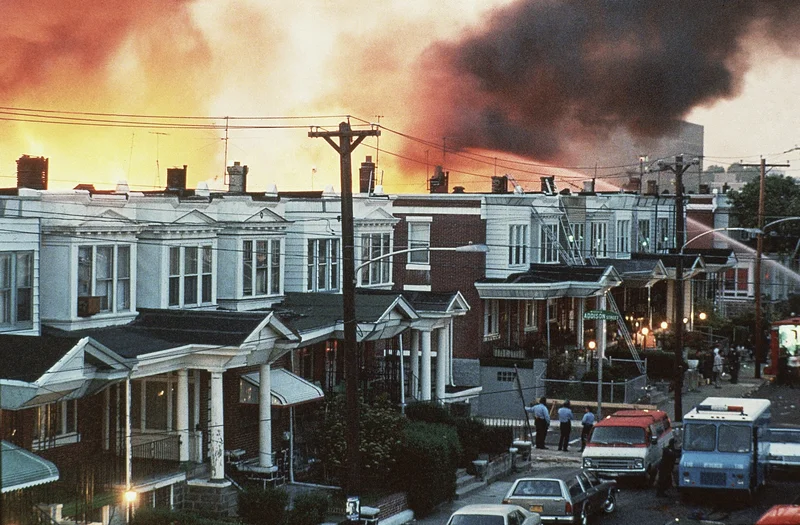
After this initial assault failed, the police constructed a bomb with their large supply of C-4. At 5:27 PM, a Pennsylvania State Police helicopter circled the house, and Lt. Frank Powell leaned out and dropped the bomb. The explosion shook the ground for blocks, quickly starting a fire on the roof of 6221. Despite the water cannons and hundreds of firefighters on the scene, the Police Commissioner and Fire Department Chief issued orders to deliberately “let the fire burn.” The inferno spread downwards through the house and engulfed the porch, raging out of control and quickly spreading to the neighboring houses.
While MOVE members desperately tried to escape out the back of their burning house, they were driven back by police gunfire. While Ramona Africa and 13-year-old Birdie Africa, both badly burned, were able to escape alive, at least one other adult and two children who emerged into the back alley were driven back by police officers, among whom were several veterans of the 1978 confrontation. Despite claims from the Mayor about handpicking police personnel, two of the cops filmed beating Delbert Africa at the 1978 confrontation were also on the scene.
As viewers, including Mayor Goode, watched on televisions across the city, the flaming inferno spread, destroying the entire block of 61 homes. When the dust settled and the flames subsided, 11 people, including six adults and five children, had been brutally murdered. Among the MOVE members killed were Rhonda Africa, Theresa Africa, Frank Africa, Conrad Africa, Raymond Africa, Tree Africa (14), Delisha Africa (12), Netta Africa (12), Little Phil Africa (11), Tomaso Africa (9), and John Africa, who’s spirit, teachings, and revolution live on. The sole adult survivor, Ramona Africa, was taken into police custody, charged with riot and conspiracy, and sentenced to seven years in prison.

Osage Avenue after the dropping of the bomb.
As the international media storm descended, the cover-up of the crimes committed by the state on May 13th began. Statements from police and the Police Commissioner confirming that cops had fired into the back alley while the block was burning were quickly recanted or “corrected,” The only weapons recovered from the ashes of 6221 were a bolt-action rifle, two shotguns, and two revolvers, while accounts from several firemen report the sound of automatic gunfire after the fire started. Police sharpshooters returned in the early morning without authorization to disturb the crime scene. A crane was used to recover the bodies of those killed, sifting through the wreckage and destroying exact recovery positions. The bodies were left unrefrigerated by Medical Examiner personnel, rendering inconclusive the delayed tests to determine the cause of death.
A Special Commission was appointed directly by Mayor Goode to investigate the tragedy and hold public hearings during the fall of 1985. During televised testimony, police, firemen, civil servants, and top city officials pointed blame everywhere but at themselves. In 1986, the commission issued its findings, harshly criticizing the government for its gross negligence and use of excessive and unreasonable force. They also confirmed that police gunfire had prevented occupants from escaping the burning house, with autopsies conducted by outside forensic experts finding ammunition fragments in six of the victims’ bodies. However, the commission did not have the power to issue indictments, and so none of those responsible for the egregious crimes were held accountable. A grand jury investigating criminal wrongdoing on the part of the city refused to issue any indictments, as did a federal grand jury investigating civil rights violations. Despite clear and decisive evidence that murder was committed in the eyes of the people, not a single person in any government position did even a day in jail for the crimes committed on May 13th.
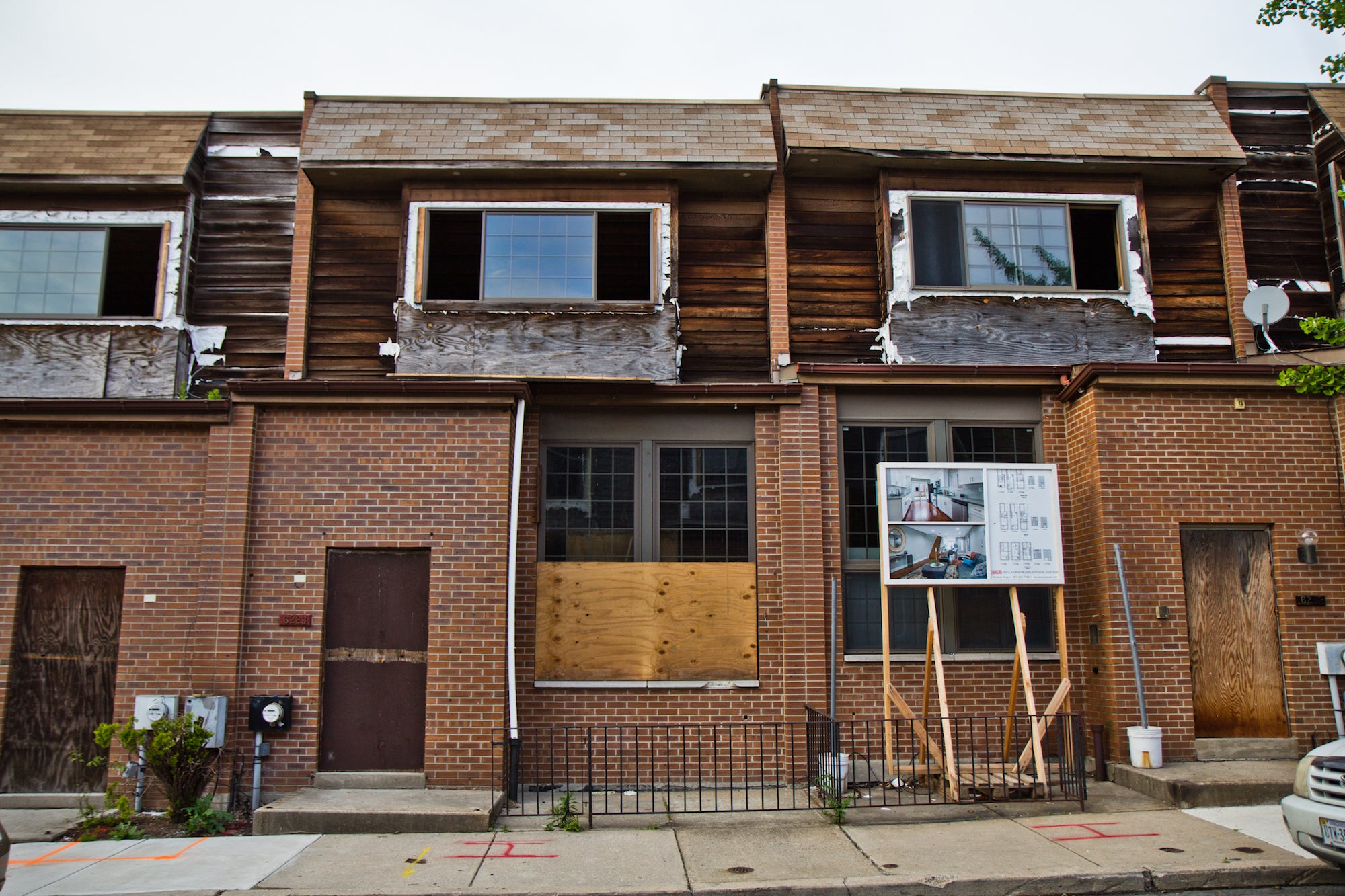
In the aftermath of the wreckage, despite promises to the residents of the 6200 block of Osage Avenue to rebuild, the city dragged its feet, leaving many residents homeless. When the houses were finally rebuilt, they were shabbily constructed, leaving many who lost their homes and possessions that day destitute in the face of the injustice that had been committed not only to MOVE but to them as well.

Renovations on the 6200 block of Osage Avenue.
Despite the devastation and loss that it faced, the MOVE Organization lives on, continuing its revolutionary activities and advocating for the release of the MOVE 9 and other political prisoners like Mumia Abu Jamal. MOVE members began gradually to be released from prison starting in 1988, with Ramona Africa finally coming home in 1992 after all she endured at the hands of the state. Young MOVE activists like Mike Africa Jr. carried on the fight to free the MOVE 9, and finally, in 2018, after 40 years of unjust imprisonment, surviving MOVE 9 members, including Mike’s parents, came home. MOVE’s revolutionary work continues to this day, with forums, demonstrations, and yearly commemorations on the August 8th and May 13th anniversaries.
In 2020, it was exposed that the Department of Anthropology at the University of Pennsylvania had kept the bodies of children killed in the MOVE bombing—without the knowledge or consent of their parents who believed the children to have been buried by the state—and used the remains in classroom “case studies.” The bodies of other victims of the bombing, initially reported to family members as having been cremated, were discovered in basement of the Medical Examiners Office. These revelations expose the ongoing injustice MOVE faces at the hands of the state and other institutions.
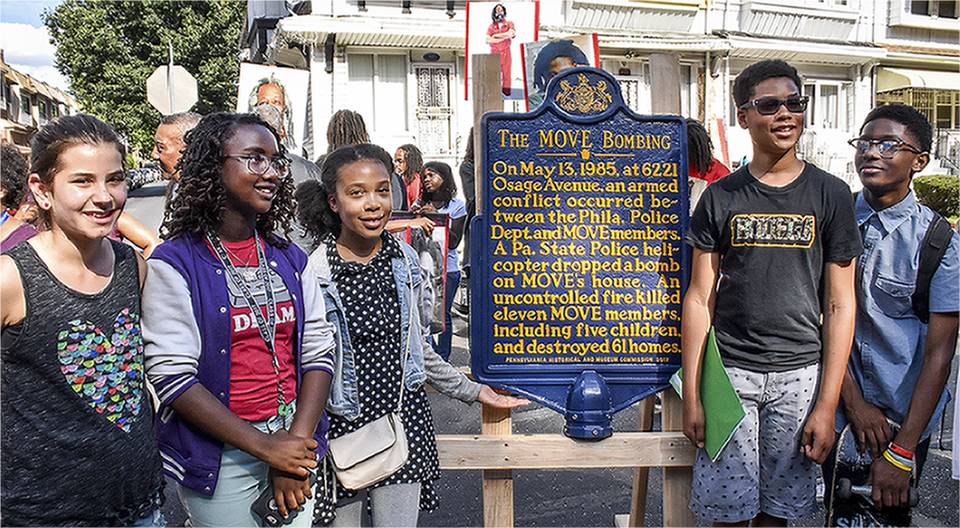
In 2017, after several years fighting resistant city officials, the children of the Jubilee School succeeded in their work alongside activists, and a historical marker was dedicated to MOVE and the events of May 13th, 1985. The marker stands at the intersection of Osage Avenue and Cobbs Creek Parkway, commemorating the legacy of MOVE and their revolutionary fight in the face of state violence. Projects like the MOVE Activist Archive continue to work today to preserve the Organization’s legacy and continue its revolutionary work.

Students of the Jubilee School at the dedication of the historic marker.
Bibliography
Africa Jr, Mike. “Fifty Years Ona Move: The History of the Philadelphia Based MOVE Organization.” Dubside. 2021.
Ann Thompson, Heather. “Saying Her Name.” The New Yorker. 2021.
Brey, Jared. “Can Philly Fix the Block It Razed, Then Shabbily Rebuilt, After MOVE Bombing?” Philadelphia Magazine. 2016.
Conde, Ximena. “Hundreds March in West Philadelphia to Remember Lives Lost in 1985 MOVE Bombing.” WHYY. 2021.
Cooper, Kylie. “In Photos: Remembering the MOVE Bombing, 36 Years Later.” The Daily Pennsylvanian. 2021.
Mariner, Cosmos. “The MOVE Bombing.” The Historical Marker Database. 2019.
Steven. “The MOVE Bombing, 1985.” libcom.org. 2007.
Tomek, Beverly C. “MOVE.” The Encyclopedia of Greater Philadelphia.
WHYY Staff. “What You Need to Know About the Desecrations of MOVE Bombing Victims Remains.” WHYY. 2021.
0 Comments